Email: admin@yeeshine-tech.com WhatsApp: +86-13712868936

- All
- Product Name
- Product Keyword
- Product Model
- Product Summary
- Product Description
- Multi Field Search

Views: 0 Author: Site Editor Publish Time: 2025-03-14 Origin: Site


Ever wondered how everyday plastic products are made? The secret is plastic injection molding. It's the process behind creating everything from bottle caps to car parts. In this article, we’ll explore the basics of plastic injection molding. You’ll learn how the process works, its key benefits, and where it’s used. By the end, you’ll understand why it’s such a crucial technique in modern manufacturing.
Plastic injection molding is a manufacturing process that involves injecting molten plastic into a precisely designed mold under high pressure. As the plastic cools, it solidifies into the shape of the mold, creating a finished part. This technique is widely used for its ability to produce high-quality, complex parts efficiently, making it a popular choice for mass production across industries like automotive, electronics, and healthcare.
The development of plastic injection molding dates back to the late 19th century when the first molding machines were introduced. These early machines were limited to simple products like buttons and combs. However, as thermoplastics such as polystyrene and PVC emerged in the 1930s, the process evolved significantly. The creation of extrusion screw machines further advanced the process, enabling the production of more intricate components. Today, plastic injection molding is a highly refined technique, used to produce parts with exceptional precision and complexity for a wide range of applications.
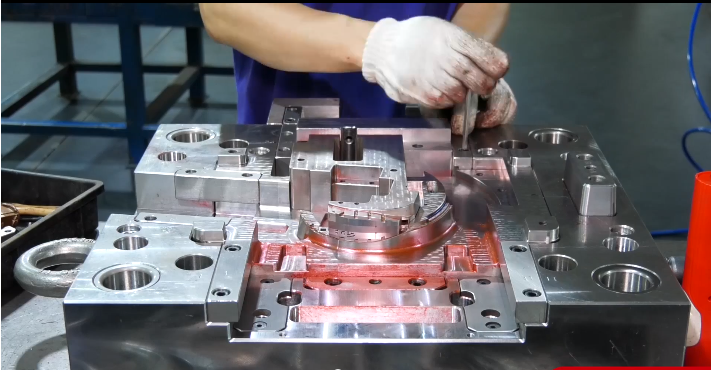
The plastic injection molding process starts with heating plastic pellets to their molten state. These molten plastics are then injected into a mold cavity, which is typically made of steel or aluminum. The mold is precisely engineered to ensure that the final product meets exact specifications. Once the cavity is filled, the molten plastic cools, hardens, and takes the shape of the mold. This process, which can be fully automated, allows manufacturers to produce large quantities of high-quality parts with minimal waste. By optimizing factors like temperature, pressure, and cooling time, the process delivers consistency across production runs, making it ideal for both small and large-scale plastic injection molding applications.

Thermoplastic injection molding is the most widely used technique in the plastic injection molding process. It involves using thermoplastic materials that can be heated, molded, and remolded without degradation. This ability to remelt and reshape makes thermoplastics ideal for producing a variety of consumer and industrial products. The process begins with heating thermoplastic pellets until they are molten, after which the molten plastic is injected into a mold cavity. Once cooled, the mold opens to reveal the final part. Thermoplastic injection molding is not only versatile but also eco-friendly, as thermoplastics can be easily recycled, aligning with modern sustainability goals in manufacturing.
In contrast to thermoplastics, thermoset injection molding uses materials that undergo a permanent chemical transformation during the molding process. Once these materials are heated and molded, they cannot be reshaped or remelted. This permanent curing process results in parts with superior heat resistance and enhanced structural integrity. Thermoset injection molding is especially beneficial for high-performance applications, including electrical components and automotive parts. The thermoset material is injected into the mold cavity and then cured under heat and pressure, ensuring durability and resistance to deformation under stress.
Overmolding is a specialized injection molding technique that enables the creation of multi-material parts in a single process. This method typically involves molding one material over another, such as adding a soft, flexible layer over a rigid substrate. Overmolding is widely applied in the production of consumer electronics, medical devices, and tools, offering both functional and aesthetic benefits. The process begins with creating a base part, which is then placed into a second mold where the additional material is injected. The result is a strong bond between the two materials, enhancing the product's performance and usability.
Insert molding allows for the embedding of metal or other rigid components into plastic parts during the injection molding process. This method eliminates the need for secondary assembly, integrating the insert directly into the molded part. Insert molding is commonly used in medical devices, automotive components, and electrical connectors, where the integration of metal components is necessary for strength and functionality. The process involves placing a pre-fabricated insert into the mold cavity before the molten plastic is injected around it. As the plastic cools, it solidifies around the insert, creating a secure bond.
Gas-assisted injection molding introduces pressurized gas into the molten plastic within the mold. The gas displaces part of the plastic, creating hollow sections and reducing material usage while maintaining part strength. This process helps to produce lighter parts with minimal warping, making it especially useful for manufacturing large structural components and furniture parts. By reducing the material used in the molding process, gas-assisted injection molding contributes to cost savings and supports sustainability efforts in plastic injection molding applications.
Micro injection molding is a specialized technique designed to produce tiny, high-precision components for industries such as healthcare, electronics, and telecommunications. This process requires highly accurate machinery that can handle extremely small quantities of plastic. The molds used in micro injection molding are designed with ultra-small cavities to create parts that measure just millimeters in size. By controlling the injection of molten plastic with exceptional precision, this method ensures the detailed replication of intricate features. Micro injection molding plays a critical role in producing tiny parts that are essential for the functioning of larger systems, making it indispensable in advanced manufacturing.
| Type of Injection Molding | Description |
|---|---|
| Thermoplastic Injection Molding | Uses thermoplastics, can be remelted and reshaped, eco-friendly. |
| Thermoset Injection Molding | Uses materials that permanently cure, high heat resistance, structural integrity. |
| Overmolding | Molds one material over another, used in electronics, medical devices. |
| Insert Molding | Embeds metal parts within plastic, eliminates secondary assembly. |
| Gas-Assisted Injection Molding | Introduces gas to reduce material use, produces lightweight parts. |
| Micro Injection Molding | Produces tiny, high-precision parts for healthcare, electronics, telecommunications. |
Thermoplastics are the most widely used materials in the plastic injection molding process due to their versatility and recyclability. Common thermoplastics like Acrylonitrile Butadiene Styrene (ABS), Polypropylene (PP), Polyethylene (PE), and Nylon can be heated, molded, and remolded multiple times without significant degradation. ABS is well-known for its toughness and is widely used in industries such as automotive and consumer electronics for items like dashboard components and protective casings. PP and PE are popular in packaging and household goods due to their lightweight nature and resistance to chemicals. Nylon, known for its strength and durability, is often used in demanding applications like gears and machine components. The ability to recycle thermoplastics aligns with sustainable practices, reducing waste and lowering production costs through material reuse.
Thermosetting plastics, including Epoxy and Phenolics, undergo an irreversible chemical change when heated, resulting in rigid, heat-resistant parts. Once molded, these plastics cannot be reshaped, making them suitable for high-performance applications that require stability under extreme conditions. Epoxy is known for its excellent adhesive properties and strength, making it ideal for coatings and adhesives that must withstand harsh environments. Phenolics, with their superior heat resistance, are commonly used in electrical components and other high-temperature applications, providing critical insulation and structural integrity. These plastics retain their properties under thermal stress, making them essential in industries such as aerospace and heavy machinery.
Elastomers, which include synthetic rubber and thermoplastic elastomers (TPE), provide flexibility and resilience similar to rubber. These materials return to their original shape after deformation, making them ideal for applications that require both durability and flexibility. Elastomers are commonly used in the production of seals, gaskets, and soft-touch components, where the ability to withstand repeated stress without permanent deformation is critical. They are widely used in automotive applications for seals and in consumer products for ergonomic grips. The versatility of elastomers allows manufacturers to create innovative solutions, enhancing product performance while improving user experience through tactile design considerations.
Injection molding offers rapid production, creating thousands or even millions of identical parts quickly. Its automation ensures efficiency, making it ideal for high-volume industries like automotive, electronics, and consumer goods.
Injection molding ensures tight tolerances and consistency in parts, crucial for industries like aerospace and medical devices where precision is vital. This process guarantees high-quality, reliable parts across large production runs.
Injection molding supports a wide range of materials, from common thermoplastics like ABS and PP to thermosetting plastics. This material versatility allows for customized properties to meet specific industry needs.
Automation reduces the need for manual labor, lowering production costs and improving efficiency. This makes injection molding cost-effective, especially for large-scale manufacturing.
Injection molding minimizes waste by controlling material usage. Excess plastic is recycled, making the process more sustainable and cost-effective compared to other methods.
Mold design and creation can be expensive, making injection molding unsuitable for small-scale production. However, large-scale production can amortize the mold cost over time.
Mold creation can take weeks or months, delaying product development. Design changes also add further delays, which can be problematic for businesses needing quick prototyping.
Once a mold is created, making design changes is costly and time-consuming. This limits flexibility, especially for products requiring frequent updates or customization.
Due to high initial costs, injection molding is inefficient for short production runs. Methods like 3D printing or CNC machining are better suited for small batches or prototypes.
The cost of the plastic injection molding process is influenced by mold complexity, material choice, and production volume. Intricate molds with multiple cavities require more resources. High-performance plastics and their processing needs (e.g., melting temperature) can also increase costs. Labor costs are lower than other methods but depend on automation levels. Larger production volumes lower the per-unit cost due to economies of scale.
Injection molding is more cost-effective for mass production than 3D printing or CNC machining. While 3D printing is ideal for prototyping or small batches, injection molding's efficiency in high-volume runs reduces per-unit costs despite high initial mold costs. CNC machining has higher labor and longer production times, making it less suitable for mass production.
Cost reductions can be achieved by simplifying designs, selecting cost-effective materials, and using multi-cavity molds to increase efficiency. Automation, production planning, and material recycling further reduce costs. Partnering with experienced manufacturers ensures cost-effective design and production.
Industry 4.0 technologies, including IoT-enabled machines, enable real-time data monitoring and predictive maintenance. AI-driven analytics optimize production efficiency and minimize downtime by forecasting potential machine issues before they arise.
Sustainable plastics like PLA and PHA, along with recycled materials, reduce environmental impact. These biodegradable plastics are gaining popularity in manufacturing, providing eco-friendly alternatives without compromising performance.
AI and machine learning are enhancing quality control by detecting defects early through data analysis. Automated inspection systems with computer vision improve defect detection accuracy, reducing manual checks.
3D printing accelerates prototype creation and mold production, reducing time-to-market. Hybrid approaches combining 3D printing and injection molding are improving design flexibility, especially for custom and low-volume parts.
Plastic injection molding is a vital process in manufacturing, offering high efficiency, precision, and cost-effectiveness. It supports mass production of diverse products, from automotive to electronics. Innovations in sustainability and AI-driven quality control are enhancing the process. For businesses, understanding injection molding’s applications and trends is essential to achieving efficient, eco-friendly production.