Email: admin@yeeshine-tech.com WhatsApp: +86-13712868936

- All
- Product Name
- Product Keyword
- Product Model
- Product Summary
- Product Description
- Multi Field Search

Views: 0 Author: Site Editor Publish Time: 2026-08-21 Origin: Site


In aerospace manufacturing, the margin for error is zero; component failure carries catastrophic safety and financial consequences, demanding manufacturing processes that guarantee absolute precision for both aircraft and spacecraft. Procurement and engineering teams must source complex, high-tolerance parts from difficult-to-machine alloys like Titanium and Inconel while balancing production scalability, strict regulatory compliance, and supply chain reliability. Evaluating how CNC machining for aerospace addresses these exact constraints—through advanced multi-axis capabilities, process automation, stringent quality control, and certified workflows—is critical for selecting the right manufacturing approach and partner for flight-critical components.
Strict Tolerance Requirements: Aerospace CNC machining routinely achieves tolerances as tight as ±0.0001 inches, essential for the safety and reliability of propulsion, avionic systems, and spacecraft assemblies.
Material Complexity: The process is uniquely capable of handling high strength-to-weight ratio materials, including Titanium, Inconel, and 7000-series Aluminum, though these require specialized tooling and expertise.
Regulatory Baselines: Partnering with facilities holding AS9100, ITAR, and emerging CMMC certifications is a non-negotiable prerequisite for ensuring traceability, data security, and compliance in aerospace machined parts.
Strategic Sourcing: Evaluating a CNC machining partner requires looking beyond machine capabilities to assess their quality management systems (QMS), First Article Inspection (FAI) processes, and supply chain risk mitigation strategies.

Aerospace manufacturing operates under extreme baseline requirements. Components must withstand massive temperature fluctuations, high-vibration environments, and intense mechanical stress. Environmental resilience is a hard requirement. Weight reduction serves as another primary success criterion. Every ounce removed from an airframe improves fuel efficiency and payload capacity. Absolute geometric repeatability is mandatory across all production runs. A replacement part manufactured today must perfectly match the original component produced five years ago. These strict criteria eliminate manual manufacturing methods from consideration, forcing engineers to rely on highly controlled, automated subtractive processes.
Computer numerical control eliminates manual variability on the shop floor. Operators do not turn handwheels; software drives servo motors and ball screws with microscopic precision. This automation ensures consistent, scalable production of complex geometries. Modern machining centers utilize automated pallet pools and tool changers that swap cutting tools in seconds without human intervention. Robotic loading systems feed raw billets into the machine and remove finished parts. These systems enable lights-out manufacturing, where machines run unattended overnight. This level of automation directly satisfies aerospace success criteria by maximizing throughput while locking in dimensional accuracy and minimizing scrap rates.
The digital thread connects engineering design directly to physical production. Engineers create 3D models using aerospace design software. Computer-Aided Manufacturing (CAM) software then translates these models into machine toolpaths. This process generates the G-code that dictates spindle speed, feed rate, and axis movement. Advanced simulation software, such as Vericut, verifies the toolpaths before cutting begins. This prevents catastrophic machine crashes and ensures design intent translates perfectly into the physical component. The seamless CAD/CAM integration leaves no room for misinterpretation on the shop floor, allowing programmers to optimize tool engagement and extend insert life.
Aerospace development requires rapid iterations. Engineers must test multiple designs before finalizing a flight-ready component. Machining bridges the gap between rapid R&D prototyping and full-scale production. Unlike injection molding or investment casting, subtractive manufacturing does not require expensive custom molds. A design change simply requires a toolpath update and potentially a new set of soft jaws. Once a prototype passes validation, the exact same machine program scales up for production. This flexibility accelerates time-to-market for new aerospace platforms and allows manufacturers to lock down the process parameters early in the development cycle.
Jet engines operate in extreme conditions. Manufacturing turbine blades, compressor discs, fan discs, and fuel nozzles requires absolute precision. These parts sit in the hot section of the engine, demanding high-temperature resistance and complex aerodynamic profiles. Advanced cnc machining aerospace technologies excel here. Multi-axis mills carve intricate cooling channels into turbine blades, preventing the blades from melting during flight. Precision turning centers machine compressor discs to maintain perfect rotational balance. Fir-tree root profiles on turbine blades require specialized creep-feed grinding and broaching operations to ensure they lock securely into the turbine rotor under massive centrifugal loads.
The airframe provides the structural skeleton of an aircraft. Wing ribs, bulkheads, and fuselage frames bear massive flight loads. Manufacturers increasingly rely on monolithic machining for these parts. This involves milling a component from a single solid billet of material, often hogging out up to 90% of the original block. Monolithic parts replace complex riveted assemblies. Eliminating fasteners reduces weight and removes potential fatigue failure points. High-speed gantry mills utilize vacuum workholding fixtures to machine these large, thin-walled aluminum structures without inducing chatter or dimensional distortion.
Space exploration introduces unique manufacturing challenges. Satellite housings, thruster components, and orbital deployment mechanisms face brutal conditions. They endure extreme thermal fluctuations and operate in a hard vacuum. These precision aerospace components must not outgas or warp in orbit. Machining processes must account for material expansion and contraction, often utilizing specialized alloys like Invar or Kovar. Thruster nozzles require perfect internal geometries to direct exhaust gases efficiently. Machined satellite housings protect delicate optical sensors and communication arrays from radiation and micrometeoroid impacts, requiring exceptional surface finishes for mating seals.
Modern aircraft rely on sophisticated electronics. Avionics systems control navigation, communication, and flight management. Precision machining provides the protective housings for these sensitive electronics. Heat sinks are milled with thin, deep fins to dissipate thermal loads from circuit boards. Radar housings require precise wall thicknesses to allow signal transmission without interference. Small connected components, like electrical connectors, EMI shielding enclosures, and microwave housings, demand fine-detail micro-machining. Tolerances on these parts often reach the single-digit micron level, requiring high-RPM spindles and miniature endmills.
Landing gear absorbs the massive impact of a touching-down aircraft. These systems rely heavily on turning operations for high-stress round and cylindrical parts. Actuators, landing gear struts, and hydraulic manifolds handle extreme fluid pressures. Materials like 300M high-tensile steel are commonly used. Superior surface finishes are critical for these components. A microscopic scratch on a hydraulic cylinder can compromise seal integrity, leading to fluid leaks and system failure. Machinists use specialized deep-hole drilling, honing, and roller burnishing operations after turning to achieve mirror-like surface finishes on seal glands and piston rods.
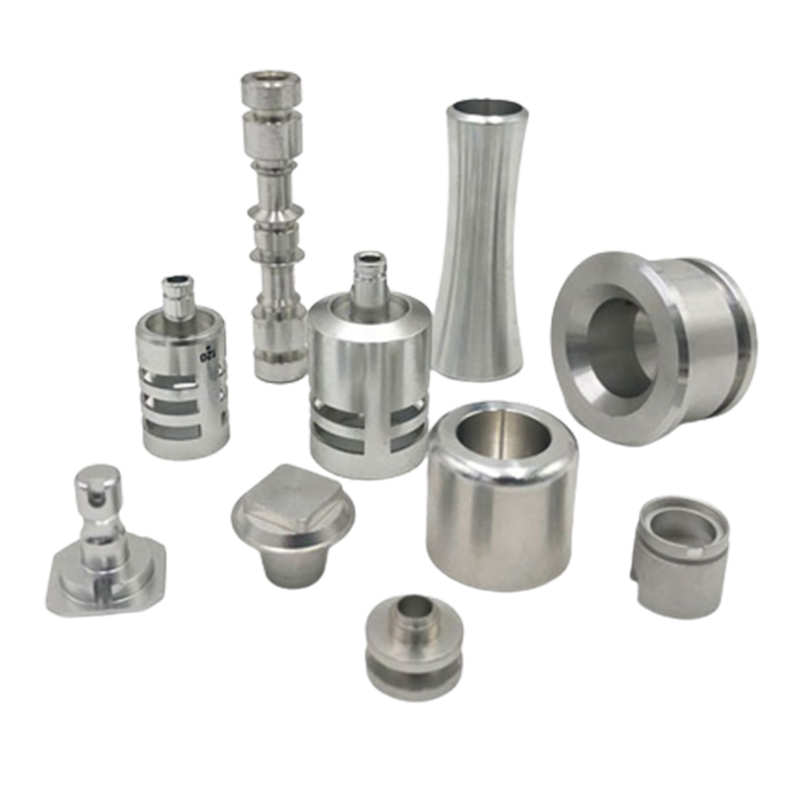
Titanium dominates high-stress aerospace applications. It offers an exceptional strength-to-weight ratio and superior corrosion resistance. Engineers specify Ti-6Al-4V for landing gear components, engine mounts, and critical structural fasteners. However, machining Titanium presents severe challenges. It has low thermal conductivity, meaning heat transfers into the cutting tool rather than the chip. This causes rapid tool wear and plastic deformation of the cutting edge. Machinists combat this using high-pressure through-tool coolant (often exceeding 1000 PSI), rigid machine setups, and optimized feed rates that maintain a constant chip load to prevent work hardening.
Aluminum remains the workhorse of the aerospace industry. Alloys like 7075 and 6061 provide excellent strength while keeping weight low. Manufacturers use aluminum extensively for lightweight structural components, wing skins, and fuselage frames. It boasts excellent machinability. High-speed machining (HSM) techniques utilize 30,000 RPM spindles and shrink-fit tool holders to remove massive amounts of aluminum quickly. Proper cutting strategies, such as dynamic milling, prevent material warping during aggressive material removal. Stress-relieving operations are often required between roughing and finishing passes to maintain dimensional stability.
The hot sections of jet engines require materials that survive inferno-like temperatures. Inconel and other nickel-based superalloys maintain their strength near their melting points. They resist oxidation and creep deformation. Machining these materials is notoriously difficult. They work-harden rapidly during cutting. If a tool rubs instead of cuts, the material surface hardens, destroying the insert immediately. Machining Inconel necessitates advanced toolpaths, highly rigid machine tools, and specialized ceramic or whisker-reinforced carbide tooling running at specific surface footage rates to shear the material effectively.
Not all aerospace parts are metal. Advanced engineering plastics play a major role in weight reduction. Materials like PEEK, Torlon, and PTFE offer high strength, chemical resistance, and excellent electrical insulation. Manufacturers use them for cabin interiors, wire routing clamps, and non-structural brackets. Machining plastics requires sharp, polished flutes to prevent melting or smearing the material. Heat buildup must be strictly controlled. Proper workholding is vital to avoid distorting these flexible materials during the cutting process, often requiring custom soft jaws or vacuum chucks.
Aerospace Machining Parameters by Material
Material Grade | Primary Aerospace Application | Machinability Level | Typical Tooling Strategy |
|---|---|---|---|
Titanium (Ti-6Al-4V) | Landing gear, engine mounts, fasteners | Difficult | Carbide inserts, high-pressure coolant, low SFM |
Aluminum (7075-T6) | Wing ribs, fuselage frames, bulkheads | Excellent | High-speed steel/Carbide, high RPM, dynamic milling |
Inconel 718 | Turbine blades, exhaust systems | Extremely Difficult | Ceramic inserts, rigid setups, constant chip load |
PEEK | Cabin interiors, electrical insulators | Good | Polished flutes, sharp cutting edges, low heat generation |
Stainless Steel (17-4 PH) | Actuators, hydraulic manifolds | Moderate | Coated carbide, flood coolant, rigid workholding |
Quality management is the backbone of aerospace manufacturing. ISO 9001 provides a baseline, but AS9100 Rev D is the mandatory standard for the aerospace industry. This certification dictates rigorous risk management, configuration control, and supplier accountability. It requires absolute traceability from raw material heat lots to the final installed component. Facilities holding AS9100 certification demonstrate they have the systems in place to prevent defects, manage corrective action boards, and ensure continuous improvement across all shop floor operations.
Defense aerospace projects involve sensitive national security data. Facilities handling defense-related aerospace machined parts must maintain ITAR (International Traffic in Arms Regulations) registration. This legal requirement controls access to technical data and hardware, restricting it to authorized personnel. Furthermore, the Cybersecurity Maturity Model Certification (CMMC) is becoming increasingly critical. CMMC ensures manufacturers protect sensitive CAD files and intellectual property from cyber threats. Secure servers, encrypted file transfers, and strict physical access controls are mandatory for compliance.
Traditional 3-axis machines move linearly along the X, Y, and Z axes. 5-axis machines add two rotational axes, typically via a trunnion table or a swivel head. This capability is vital for aerospace applications. 5-axis machining allows the cutting tool to approach the workpiece from virtually any angle. It reduces setup times by allowing a part to be machined on five sides in a single operation. This minimizes human error associated with manually repositioning parts. It also allows for the continuous simultaneous machining of complex contoured surfaces, such as impellers, blisks, and turbine blades.
Aerospace quality control relies on advanced metrology. Coordinate Measuring Machines (CMM) verify complex geometric dimensioning and tolerancing (GD&T). These machines use touch probes or scanning lasers to measure parts down to the micron. Strict surface roughness (Ra) requirements dictate aerodynamic efficiency and hydraulic sealing. Inspectors use profilometers to verify surface finishes. The AS9102 First Article Inspection (FAI) report is standard practice, providing comprehensive documentation proving the first production part meets all engineering specifications. Non-destructive testing (NDT), like dye penetrant and ultrasonic inspection, verifies internal integrity without destroying the part.
Additive manufacturing (3D printing) is gaining traction in aerospace. It excels at creating complex internal geometries, like conformal cooling channels, that subtractive tools cannot reach. However, machining remains superior for production volume, material properties, and surface finish. Machined parts exhibit uniform grain structures and superior fatigue strength compared to the layered structure of printed parts. Often, manufacturers use a hybrid approach. They 3D print or cast a near-net shape component and then use precision milling and turning to hit the final tight tolerances on mating surfaces and bearing journals.
Several factors influence the final per-part cost in aerospace machining. Material removal rate (MRR) and cycle time are primary drivers; longer machining times increase costs. Exotic materials like Inconel drastically slow down cycle times and increase consumable tooling costs. High scrap rates on expensive titanium billets destroy profit margins. Engineers must evaluate the trade-off between designing for manufacturability (DFM) and achieving optimal aerodynamic performance. Opening up internal corner radii to accommodate larger endmills or standardizing tapped hole sizes can drastically reduce machining time without compromising structural integrity.
The aerospace supply chain is notoriously volatile. Securing aerospace-grade Titanium and Inconel forgings often involves massive lead times. Waiting 40 to 50 weeks for raw material mill runs is common. This volatility threatens production schedules. Procurement teams must implement mitigation strategies. Blanket orders secure machine time and material allocation in advance. Strategic material stockpiling and consignment inventory buffer against sudden supply chain disruptions. Accurate forecasting allows machining partners to order raw materials long before the actual production run begins.
Counterfeit materials pose a severe risk to aviation safety. Undocumented process deviations can lead to catastrophic part failure mid-flight. Strict traceability mitigates these risks. Every component must trace back to its original raw material heat number. Material Test Reports (MTRs) verify the exact chemical composition and mechanical properties of the metal. Certificates of Conformance (CoC) guarantee the part was manufactured according to the approved drawing and revision level. Permanent part marking, such as dot peen or laser engraving, ensures this traceability remains intact throughout the component's lifecycle.
Subtractive manufacturing remains the foundational technology for the aerospace sector. It is uniquely capable of meeting the industry's uncompromising demands for precision, material strength, and repeatability. Whether producing commercial aviation airframes or deep-space exploration thrusters, machining delivers the required reliability. When evaluating a partner for aerospace CNC machining, look beyond basic equipment lists. Prioritize verifiable AS9100 and ITAR certifications. Demand proven experience with exotic alloys, advanced 5-axis capabilities, and robust in-house metrology.
To move forward with your aerospace manufacturing project, take the following actionable steps:
Conduct a comprehensive facility audit of shortlisted vendors to verify their quality management systems, machine maintenance logs, and cybersecurity protocols.
Request sample AS9102 First Article Inspection (FAI) documentation to evaluate their metrology equipment and reporting accuracy.
Submit initial CAD models under an NDA for a Design for Manufacturability (DFM) review to identify cost-saving geometry adjustments before locking in the design.
Establish blanket orders for raw materials early in the development cycle to mitigate long lead times for exotic alloys.
A: Aerospace components typically require tolerances ranging from ±0.001 inches down to ±0.0001 inches. The exact requirement depends heavily on the application. Engine components, bearing journals, and hydraulic seals demand the tightest tolerances, while cabin interior brackets may allow slightly looser specifications.
A: 5-axis machining allows the cutting tool to approach the workpiece from any angle. This enables the creation of complex organic shapes like turbine blades in a single setup. Reducing setups increases dimensional accuracy, eliminates manual repositioning errors, and drastically reduces overall production time.
A: Aluminum alloys, specifically 7075 and 6061, are most common for structural frames due to their lightweight properties and excellent machinability. Titanium and Inconel are the standard choices for high-stress and high-temperature environments, such as landing gear and jet engines.
A: AS9100 is a standardized quality management system specific to aerospace. It ensures the machining facility maintains strict traceability, risk management, and quality control processes. This certification is required by aviation regulatory bodies to guarantee part safety, reliability, and supplier accountability.
A: Inconel work-hardens rapidly, which destroys standard cutting tools. Machinists combat this by using highly rigid machine setups, specialized ceramic or whisker-reinforced carbide inserts, and optimized toolpaths that maintain constant chip loads to prevent the material from rubbing and hardening.
A: The AS9102 FAI is a comprehensive verification process. It documents that the very first production part meets every single engineering specification, dimension, surface finish, and material requirement on the drawing before full-scale production is allowed to begin.


